
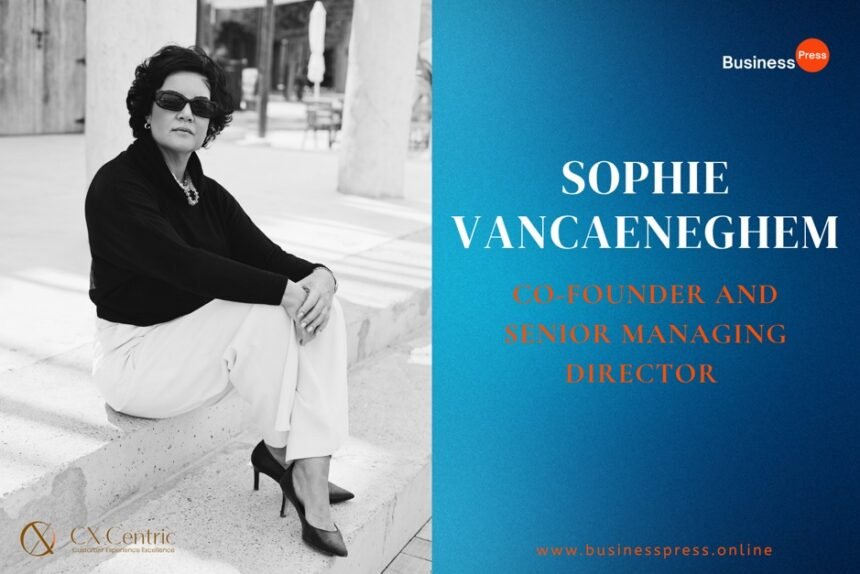
For Sophie Vancaeneghem, customer experience is not a department—it is the heartbeat of a successful business. As Co-Founder and Senior Managing Director of CX Centric, she has dedicated her career to helping organizations create experiences that people remember and workplaces where employees can thrive.
With extensive experience spanning aviation, hospitality, retail, healthcare, and service industries, Sophie combines operational expertise with a deep understanding of human behaviour. Her work focuses on helping organizations build cultures where exceptional service, employee engagement, and commercial success go hand in hand. Through CX Centric, she continues to champion a more human approach to business—one where meaningful experiences become a lasting competitive advantage.
Leadership with a Global Vision
We started the interview by asking, “How have global experiences shaped your leadership philosophy over the years?”
Sophie shared, “Working across different countries, cultures, and industries changes the way you see people. You quickly realize that leadership is not one fixed style. What works in one environment may not work in another. Global exposure teaches adaptability. But it also teaches humility.
Some of my most valuable lessons did not come from boardrooms. They came from airports, hotel back offices, and frontline teams, observing how people communicate under pressure, or how they handle uncertainty, and recover when things do not go as planned.
Travel also teaches you something important about perception. The same action can be interpreted differently depending on one’s culture, background, religion, age, and life priorities. This means that leadership requires emotional intelligence, listening first and often being the last one to speak, curiosity, and self-awareness. I think global experience makes you less certain — but more open, and that openness becomes a strength.”
A Human-Centric Leadership Approach
Intrigued to understand what human-centered leadership means to Sophie Vancaeneghem in today’s business landscape, we asked her to share the same.
“Human-centered leadership is often misunderstood. It does not mean lowering standards, it means understanding people well enough to create environments where they can perform at their best.
I have always believed that employees are not simply resources; they are experienced, creators. The way a team feels internally eventually becomes visible externally. Human-centered leadership means paying attention to what is not always said: energy, motivation, confidence, and fatigue. It means creating psychological safety, allowing people to contribute ideas, giving ownership, and recognizing that performance improves when people feel respected. In high-pressure industries, especially, humanity is not soft, it is a strategy,” she explained.
Embracing the Human Element in Business
In an increasingly digital world, it is becoming a tough task for businesses to preserve authentic human connections. To learn how to approach this challenge from the perspective of an expert, we asked Sophie Vancaeneghem.
She reflected, “Technology should remove effort, not emotion. That is an important distinction. Digital tools can make experiences faster, smoother, and more efficient, but not always. Working your way through multiple menus that do not list your issue, then struggling to access a ‘human’ is not progress, it is a setback. Technology cannot replace the human connection that comes from noticing people, listening, personalizing interactions, or responding with empathy.
One of the most powerful moments I remember happened in a very simple environment. A small café, with nothing particularly luxurious. The waitress noticed that I am left-handed, and when she brought my coffee, she gently turned the handle to the left, smiled, and walked away. I sat in silence for a moment, completely amazed. No technology, no loyalty app — just attention. That moment mattered. Because observations and recognition create belonging.
Businesses should use technology to create space for human interaction, not replace it. The goal is not to remove people from the experience. It is to allow people to focus on what humans do best: connection.”
Plans we asked Sophie Vancaeneghem
As a firm that empowers businesses that truly want a change, CX Centric is known for its impact. So, we asked Sophie Vancaeneghem, “What is your long-term vision for CX Centric and the impact you hope to create?”
She mentioned, “The long-term vision for CX Centric has always been about influence beyond consulting. I would like us to help shape how organizations think about experience at a deeper level, not as a department, or as a trend, but as a strategic mindset. We work across many industries — aviation, hospitality, healthcare, retail, and government. And what connects them all is people.
The future I hope for is one where customer experience becomes more human, more thoughtful, and more intentional. I would like CX Centric to continue helping businesses move from transactional thinking toward emotional connection. To create workplaces where employees feel empowered, and experiences that customers genuinely remember.
For me, impact is not about scale alone. It is about relevance, depth, and meaningful change.”
Building a Strong Legacy
We then asked, “What legacy would you like your work and leadership to leave behind?”
“I think about legacy less in terms of achievements, and more in terms of the moments people remember without realizing they are remembering them.
Like the waitress who observed me being left-handed; nothing was said, and she had simply noticed. Most people in the room probably never saw it, but it stayed with me because it said something important. Someone was paying attention and cared enough to notice. I think that is what I have always believed customer experience should be. Not performance, or scripted gestures, but awareness, and the ability to see people properly.
If there is a legacy I would hope to leave behind, it would be helping businesses understand that experience is rarely built in the grand moments. It lives in the details, in how people are welcomed, reassured, or are made to feel comfortable without needing to ask.
I would hope CX Centric is remembered for bringing that perspective into business conversations — reminding organizations that operational excellence and humanity should never sit separately. And personally, I would hope to be remembered as someone who stayed curious about people. Someone who noticed. Because often, the most meaningful experiences are the ones that feel almost invisible. Small enough to go unnoticed by many. But important enough to stay with someone for years,” Sophie added.
Connect with Sophie Vancaeneghem on LinkedIn to gain industry insights.
Find CX Centric on LinkedIn and visit https://cxcentric.co/ to learn more.
Also Read:-
Dr. Amir Toren: Transforming Life Sciences And Veterinary Diagnostics At BioGal
Anthony Penwright | Leading Global Smart City & Digital Innovation Initiatives