
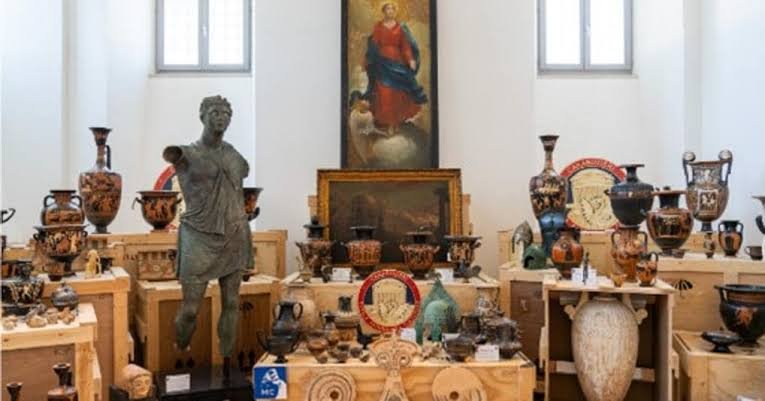
Protecting cultural heritage is achieved not only by recovering stolen works but also by reconstructing their history, identifying suspicious market movements, and training individuals responsible for their protection.
On this front, Italy and African countries are strengthening their collaboration against the illegal trafficking of cultural property. As part of this effort, the Piano Mattei includes a new professional training program.
École du Patrimoine Africain (EPA), an institution in Porto-Novo, Benin, that specializes in preserving and developing African cultural heritage, and Italy’s National School for Cultural Heritage and Cultural Activities have entered into a three-year partnership that established this program.
The first course, which started earlier this month, represents nine French-speaking African nations and welcomes professionals from those countries. Additionally, the Carabinieri Command for the Protection of Cultural Heritage (TPC) is participating in the operations, bringing its investigative expertise and the knowledge it has gained through international collaboration.
Against a backdrop of looting, illegal exports, and disputes over the restitution of works, cooperation on cultural protection is underway. The situation with the Axum obelisk in Ethiopia is particularly significant for Italy-Africa relations.
It was during the fascist occupation in 1937 that Italian troops removed the monument, which was a stele that dated back around 1,700 years, and brought it to Rome. In 2005, Italy finally returned it to Ethiopia after decades of pleas and talks. The monument was reconstructed at its original location in 2008, with assistance from UNESCO and Italian funds. The monument was relocated in three huge sections. It is an example of international cooperation that requires not just a political agreement but also significant technical and logistical work.
Also Read:
Dr. Sofica Bistriceanu | Where Medicine Meets Meaning
Lusine Aghajanyan On AI-Driven Maritime Strategy | Lunova Maritime