
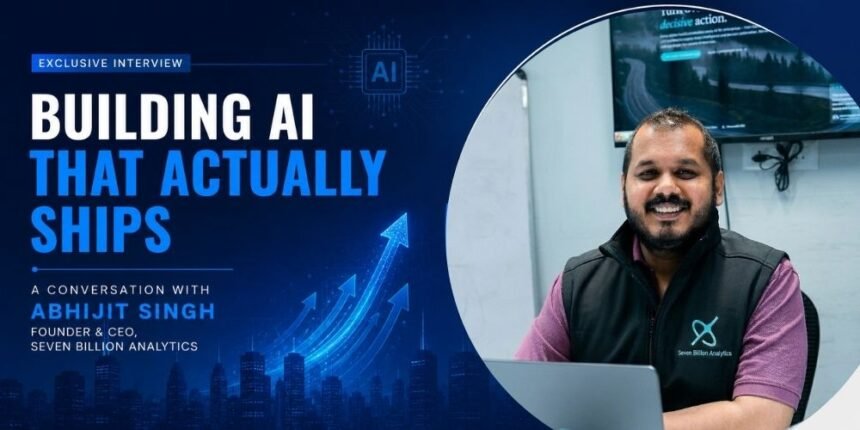
When Data Is Not Enough: Abhijit Singh on Building AI That Closes the Decision Gap
In most enterprise boardrooms, data has never been more abundant. Dashboards proliferate, business intelligence platforms generate reports in real time, and analytics teams have grown considerably over the past decade. And yet, when it is time to make the call on production volumes, inventory positions, or distribution plans, many organizations still fall back on gut instinct, the loudest voice in the room, or a spreadsheet no one fully trusts.
Abhijit Singh has spent his career trying to close that gap.
As the Founder and CEO of Seven Billion Analytics, Abhijit leads an AI and decision intelligence consultancy serving FMCG, manufacturing, supply chain, and agri-food enterprises across India and the Middle East. Over more than five years at the helm, he has led the design, development, and production deployment of forecasting models, reinforcement learning systems, and AI agents — building solutions that do not stop at the insight, but follow through to the decision itself.
Abhijit describes himself as a decision intelligence practitioner first and an entrepreneur second. That ordering is deliberate. His frustration with the gap between data and action is the founding thesis of Seven Billion Analytics: that the bottleneck in most organizations is not the quality of their data or the sophistication of their models, but the absence of a clear, codified decision process for AI to support and ultimately accelerate.
In this exclusive interview, Abhijit speaks candidly about why most enterprise AI projects never make it to production, what it actually takes to build systems that work under real-world operating conditions, and why the rise of AI agents is about to compress the time between insight and action to near zero. He also introduces VaaniOS, Seven Billion’s voice AI platform designed to serve the millions of supply chain participants in India’s emerging markets who will never use a mobile app — but do pick up the phone.
From demand forecasting at SKU level for one of India’s largest ready-to-eat food brands, to a reinforcement learning production planner that delivered a 63% improvement over a fixed baseline for a fast-growing pharmaceutical company, Abhijit’s work illustrates what enterprise AI looks like when it is built for outcomes rather than demonstrations.
This conversation covers enterprise AI strategy, the last-mile problem in analytics, the governance frameworks that make AI trustworthy enough to actually use, and the practical advice Abhijit gives to any CEO who knows AI matters but does not know where to begin.
Key Takeaways from This Interview
- The real gap in enterprise analytics is not data — it is the last mile between a number on a screen and a confident, defensible decision.
- Most enterprise AI projects fail because they start with technology rather than a clearly defined business decision and success metric.
- Getting a model working is the easy part; integrating it with legacy systems, earning team trust, and running it reliably in production represents the majority of the real work.
- AI cannot automate judgment that has not been codified — organizations must define how they make decisions before agents can execute those decisions at scale.
- VaaniOS demonstrates that voice AI can reach participants in supply chains who will never interact through a mobile app, serving real production use cases in regional Indian languages.
- The future of AI agents is tiered: autonomous handling of routine decisions with well-designed human-in-the-loop escalation for exceptions.
- Trust and governance in AI systems are architectural decisions made at the start of a project, not features added at the end.
- Explainability is not a compliance checkbox — it is the quality that makes an AI system trustworthy enough to actually use in high-stakes operational contexts.
- For CEOs beginning their AI journey, the right entry point is one specific, high-frequency, high-cost decision — not a technology strategy document.
- Seven Billion Analytics measures success by confidence in judgment, not just model accuracy.
The Full Interview
Q1: Abhijit, tell us a little about yourself and what Seven Billion Analytics does.
Abhijit opens with a founding philosophy that sets the tone for everything that follows: decisions come before dashboards.
I’m a decision intelligence practitioner first, entrepreneur second. Seven Billion Analytics is an AI and decision intelligence consultancy working with FMCG, manufacturing, supply chain, and agri-food companies across India and the Middle East. We don’t sell dashboards or reports. We build systems that close the gap between data and the actual decisions organizations need to make: faster, with more confidence, and with measurable business outcomes.
The name reflects the core belief: every person on this planet makes decisions, and most of them are made with poor information under time pressure. We’re building the infrastructure to change that, starting with enterprises.
💡 Expert Insight: Abhijit’s framing positions Seven Billion Analytics not as an analytics vendor but as a decision infrastructure company. The distinction — outcomes over outputs — shapes every engagement the firm undertakes.
Q2: What problem were you trying to solve when you started the company?
Reflecting on the founding moment, Abhijit describes a pattern he encountered repeatedly across organizations that had already invested heavily in analytics.
Every organization I walked into had invested heavily in analytics. Beautiful dashboards, real-time reporting, multiple BI tools. And yet their planning meetings were still driven by gut feel, by the loudest voice in the room, or by a spreadsheet nobody fully trusted.
The gap wasn’t data. They had data. The gap was the last mile: the distance between a number on a screen and a confident, defensible decision. Nobody was solving that. Everyone was selling better visualization. I wanted to solve for the decision itself: what is the right call, why is it the right call, and what is the cost of being wrong? That is what Seven Billion was built around.
💡 Expert Insight: The ‘last mile’ concept — the distance between data and decision — is the organizing idea behind Seven Billion Analytics. Identifying this gap, and refusing to accept better visualization as a solution to it, is what drove the company’s founding.
Q3: What is the biggest misconception enterprises have about AI today?
On enterprise AI adoption, Abhijit identifies a widespread and costly misunderstanding about where the real obstacle lies.
That it is a capability problem. Executives think: if I get the right model, the right vendor, the right platform, transformation will follow. So they buy, they pilot, they announce. And then nothing changes.
The real problem is almost never the AI. It is that the organization has not defined what a good decision looks like in the first place. You cannot automate judgment you have not codified. AI amplifies your decision-making process, which means if that process is broken, AI breaks it faster and at greater scale.
💡 Expert Insight: One of the most direct statements in this interview: AI amplifies existing decision-making processes, not replaces them. Organizations with poorly defined decision logic will find that AI makes their problems faster, larger, and harder to reverse.
Q4: Why do most enterprise AI projects fail before reaching production?
Abhijit identifies three root causes for AI project failure, presented in the order he encounters them most frequently in practice.
Three reasons, in the order I see them most often.
First, they start with the technology instead of the decision. Someone reads about large language models or computer vision and asks ‘where can we use this?’ Wrong question. The right question is: which decision, if made better, is worth the most to this business?
Second, they underinvest in the last ten percent. Getting a model working in a notebook is straightforward. Getting it integrated with legacy systems, trusted by the team acting on it, and running reliably in production: that is seventy percent of the real work, and most pilots treat it as an afterthought.
Third, they never define success before they start. Without a clear metric tied to a business outcome, every project drifts into research. And research projects do not ship.
💡 Expert Insight: The ‘last ten percent’ insight is particularly instructive: Abhijit estimates that production integration, team trust-building, and reliable deployment represent approximately seventy percent of the real work, yet most enterprise pilots treat this phase as an afterthought rather than the primary engineering challenge.
Q5: Can you share a specific project that demonstrated the real-world impact of what you build?
Moving from principles to practice, Abhijit describes two production deployments that illustrate what decision-focused AI looks like when it reaches enterprise scale.
Two stand out.
The first was with one of India’s largest South Indian ready-to-eat food brands, a household name distributed nationally. We built a demand forecasting system at SKU level, combining statistical and machine learning models across a complex, high-SKU portfolio. We reached sub-10% error rates and significantly improved on-time, in-full delivery performance. But the moment that mattered was when their supply chain head looked at the output and said: ‘For the first time, I can defend my production plan to the CFO without going on instinct.’ That sentence is what I build toward. Not accuracy numbers. Confidence in judgment.
The second was a reinforcement learning-based production planner for one of India’s fastest-growing pharmaceutical companies dealing with a chronic overproduction problem across hundreds of SKUs. The trained policy produced a 63% improvement over their fixed baseline. What made it significant was that the system learned the trade-offs the business actually cared about. It was not optimizing a formula someone had written. It was learning from outcomes. That is a fundamentally different kind of intelligence.
💡 Expert Insight: These case examples reveal a consistent philosophy: technical performance metrics (error rates, percentage improvements) are necessary but not sufficient. The true measure of success is whether a senior decision-maker gains the confidence to defend their decisions — a human outcome that no accuracy score can fully capture.
Q6: You work extensively with voice AI through your platform VaaniOS. What opportunity does that address?
Abhijit turns to one of Seven Billion’s most distinctive bets: building AI for the segments of the supply chain that digital platforms have consistently failed to reach.
Most AI investment flows toward digital, app-native users. But in India and across emerging markets, entire supply chain layers — distributors, field agents, small retailers — do not use apps. They use phone calls, in Hindi, in Punjabi, in regional dialect.
VaaniOS is a voice AI platform built for exactly this context. One agent handles FMCG distributor order capture. Another manages healthcare front desk interactions. The stack combines Indian-language speech recognition, neural voice synthesis, and reasoning models for conversation management.
The use case I am most proud of is an agri-distributor in Haryana where farmers, many illiterate, call in to place orders in Haryanvi. VaaniOS handles that interaction end to end, with a human-in-the-loop approval queue for anything that needs escalation. That is not a demo. That is production. And it reaches people that no app ever will.
💡 Expert Insight: VaaniOS illustrates a significant market opportunity that mainstream AI investment has overlooked: the millions of supply chain participants in emerging markets who interact through voice rather than screens. The Haryana case study — serving illiterate farmers in a regional dialect, fully in production — demonstrates the depth of this commitment.
Q7: How do you see AI agents reshaping enterprise operations over the next five years?
Looking ahead, Abhijit offers one of the interview’s most consequential predictions about the direction of enterprise AI.
Agents are going to compress the time between insight and action to near zero. That is the fundamental shift. Today, even with good analytics, a human reads the output, interprets it, decides, and acts. Agents collapse that chain.
Over the next five years, I expect agents to own entire operational workflows, not just assist with them. Replenishment ordering, dispute resolution, compliance checks, onboarding. The organizations that will benefit most are those that have already codified their decision logic. If you have not defined how you make decisions, you have nothing for an agent to execute. That preparation work is what most companies are not doing right now.
The model I believe in is tiered: agents handle the routine autonomously and escalate the exceptional to humans. Full automation is brittle. Full manual review defeats the purpose. The middle path, with well-designed human-in-the-loop checkpoints, is where the real value is.
💡 Expert Insight: The tiered agent model — autonomous for routine, escalation for exceptional — reflects a mature engineering philosophy that resists both the hype of full automation and the caution of full human oversight. The insight that decision codification is prerequisite to agent deployment is a practical directive organizations can act on today.
Q8: How should organizations approach trust and governance in AI systems?
On the question of AI governance, Abhijit draws an analogy to financial controls — reframing governance not as friction but as foundation.
Trust is not a feature you add at the end. It is an architectural decision you make at the beginning.
Every AI system should have a defined owner, a defined escalation path, and a defined failure mode. Who is accountable when the forecast is wrong? What happens when an agent makes an unexpected call? If you cannot answer those questions before you deploy, you are not ready to deploy.
The systems I am most confident in are ones where a human can look at an AI output and understand why it said what it said, not just what it said. Explainability is not a compliance checkbox. It is the thing that makes a system trustworthy enough to actually use. Treat AI governance the way you treat financial controls: not as friction, but as the foundation that makes everything else reliable.
💡 Expert Insight: The financial controls analogy reframes AI governance in terms business leaders already understand. Explainability emerges not as a regulatory burden but as the practical requirement for operational trust — the quality that determines whether a system gets used or ignored.
Q9: What advice would you give to a CEO who knows AI matters but does not know where to begin?
For leaders at the starting line, Abhijit offers advice that is deliberately narrow, concrete, and counter to how most AI strategy conversations begin.
Start with one decision, not one technology.
Find the decision that is made most frequently in your business, costs the most when it is wrong, and currently relies on the least structured input. That is your first AI use case. Not because it is the most exciting — it probably is not — but because it is the most measurable. You can improve it. You can show results in a quarter. After that, the internal conversation changes. You are no longer talking about AI in the abstract. You are talking about what it did for your demand planner or procurement lead last month.
Do not start with a strategy document. Start with a problem.
💡 Expert Insight: ‘Do not start with a strategy document. Start with a problem.’ This instruction cuts through much of the planning overhead that stalls enterprise AI initiatives. Prioritizing measurability over excitement is a discipline that turns AI conversations into AI results.
Q10: What is your long-term vision for Seven Billion Analytics, and what legacy do you hope to leave?
In closing, Abhijit articulates the long-term ambition and the professional legacy he is building toward — one that begins and ends with the decision.
The long-term vision is to build the decision intelligence infrastructure layer for organizations shaping real industries: supply chains, food systems, healthcare access, manufacturing. Not a dashboard company. Not an AI vendor. A partner that makes enterprises measurably better at the thing that matters most: making good calls under uncertainty.
The legacy I want is simple. I hope people will say that we understood early that the bottleneck was never data. It was always judgment. And that we spent our careers building systems to close that gap.
If the organizations we have worked with are making faster, more confident, more consequential decisions because of what we built, that is the career worth having.
💡 Expert Insight: The legacy Abhijit describes is defined entirely in terms of the organizations he serves, not the company he has built. This other-directed framing — measuring success by the quality of client decisions rather than company metrics — is consistent with the decision-first philosophy that runs through every answer in this interview.
Frequently Asked Questions
Q: What does Seven Billion Analytics do?
Seven Billion Analytics is an AI and decision intelligence consultancy working with FMCG, manufacturing, supply chain, and agri-food companies across India and the Middle East. Rather than selling dashboards or reports, the firm builds systems that close the gap between data and the actual decisions organizations need to make, with a focus on speed, confidence, and measurable business outcomes.
Q: Why do most enterprise AI projects fail to reach production?
According to Abhijit Singh, three factors are most common: starting with technology rather than a defined decision; underinvesting in production integration, which represents the majority of the real work; and failing to define success metrics tied to business outcomes before the project begins.
Q: What is the biggest misconception enterprises have about AI?
Abhijit argues that most executives treat AI as a capability problem — believing that the right model or platform will drive transformation. In reality, the more fundamental issue is that organizations have not defined what a good decision looks like. AI amplifies existing decision-making processes, so an undefined or broken process becomes a larger problem at greater speed.
Q: What is VaaniOS and who is it designed for?
VaaniOS is a voice AI platform built for supply chain participants in India and emerging markets who do not use apps. It combines Indian-language speech recognition, neural voice synthesis, and reasoning models to handle interactions such as distributor order capture and healthcare front desk management. One production deployment serves farmers in Haryana who place orders in Haryanvi, with a human-in-the-loop escalation queue for edge cases.
Q: How does Abhijit Singh recommend organizations approach AI governance?
He recommends treating governance as an architectural decision made at the start of a project, not a feature added at the end. Every AI system should have a defined owner, escalation path, and failure mode. Explainability — the ability for a human to understand why an AI produced a given output — is not a compliance checkbox but the quality that makes a system trustworthy enough to use operationally. The analogy Abhijit uses is financial controls: governance as foundation, not friction.
Q: What role will AI agents play in enterprise operations over the next five years?
Abhijit expects agents to own entire operational workflows, not just assist with them — including replenishment ordering, dispute resolution, compliance checks, and onboarding. The key precondition is codified decision logic: if an organization has not defined how it makes decisions, it has nothing for an agent to execute. He advocates a tiered model where agents handle routine decisions autonomously and escalate exceptional cases to humans.
Q: What advice does Abhijit Singh give to a CEO starting their AI journey?
Start with one decision rather than one technology. Identify the decision made most frequently, with the highest cost of error, and currently supported by the least structured input. Prioritize measurability over excitement, set a timeline to show results within a quarter, and resist the temptation to begin with a strategy document. Begin with a problem.
Q: What is the long-term vision for Seven Billion Analytics?
To build the decision intelligence infrastructure layer for organizations in supply chains, food systems, healthcare access, and manufacturing — operating as a partner that makes enterprises measurably better at making good decisions under uncertainty, rather than as a dashboard company or AI vendor.
Also Read:-
Lusine Aghajanyan On AI-Driven Maritime Strategy | Lunova Maritime
Ravi Singh & Kickin’Inn Australia: Modern Hospitality Leader