
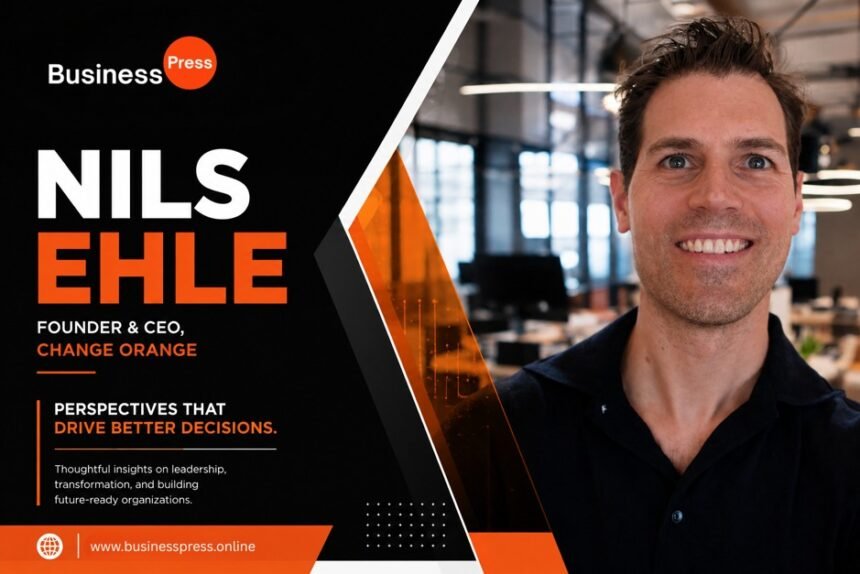
There’s a particular kind of executive Nils Ehle has learned to recognize instantly: the one who wants an AI success story on the next board deck within a quarter. As Founder & CEO of Change Orange, Nils Ehle has spent much of the past decade explaining, patiently but firmly, why that instinct is precisely what causes AI transformations to fail.
A Track Record Built Inside Large Organizations
Nils Ehle’s grounding in transformation work runs deep. He began at Accenture before moving to E.ON, where he progressed from IT transformation into the operational sales business, work that took him progressively closer to where real commercial challenges lived. In 2012, he was given a mandate to build an international transformation unit spanning 12 country markets, reporting directly to the board. From there, Nils Ehle helped establish a cross-company innovation hub in Germany’s Ruhr Valley, uniting around 80 organizations, competitors included, to match emerging solutions to genuine business problems.
Change Orange, founded in 2015, has since evolved from a boutique consultancy into a firm fully dedicated to AI business transformation delivered in what Nils Ehle describes as a human-first way. The practice’s remit today spans AI strategy development, end-to-end AI business transformation, business model and operating model change, workforce capability building, and the change management work that determines whether any of it survives contact with the organization. “Boards want a maturity score and a use case pipeline,” Nils Ehle says. “What actually moves the needle is staying with a company through the strategy, the operating model, and the people work that follows.”
The Maturity Model Behind the Method
Central to how Nils Ehle structures client engagements is Change Orange’s six-dimensional AI Business Maturity Model, spanning data, technology infrastructure, organization and process, individual and team skill, the alignment between AI portfolio and business strategy, and leadership culture. “AI business transformation is not a use-case sport. It’s a capability-building exercise,” he says. Tellingly, only two of the six dimensions are directly about AI. “The other four have nothing to do with AI as such. They are about core organizational strength.”
Case Study: Transforming a Global Pharmaceutical Supply Chain
The engagement Nils Ehle returns to most often as proof of concept involved the digital supply chain of a large global pharmaceutical company. Rather than designing the new structure on paper and rolling it out later, his team redesigned the organization while running it under the new model, placing people directly into their new roles so they could drive the change from inside their own functions. Within a single year, the entire organization had been transformed. “Not a deck on a shelf, but a working organization run by empowered people,” Nils Ehle says.
Rethinking Leadership as AI Absorbs Task Management
Nils Ehle argues that AI’s capacity to take over routine managerial tasks is forcing leadership itself to evolve. “That’s a big shift, from the management of tasks to the leadership of people,” he says. His seven-dimensional leadership model covers willingness to learn, emotional intelligence, data and technology fluency, adaptability, systemic thinking, creativity, and courage to change.
He frequently uses the image of the elephant, whose heart weighs roughly five times more than its brain, to make his point about where modern leadership has drifted. “Most modern leadership is built on the opposite imbalance, heavy on analysis, light on heart,” Nils Ehle explains. “The leaders succeeding in the age of AI are shifting deliberately toward heart-based leadership.”
Building AI Products Alongside the Consulting Practice
Beyond advisory work, Nils Ehle has partnered on AI Use Case Engine, a real-time system that breaks a company into its business capabilities and then proposes, benchmarks, and prioritizes AI and automation use cases against real-world precedents, scored for compliance and shaped into a portfolio and roadmap. “We deliberately run the engine alongside human experience and intuition that AI alone can’t provide,” he says, a combination he calls narrow artificial intelligence paired with general human intuitive intelligence.
The Risk Boards Underestimate
Citing recent MIT Media Lab research on cognitive debt, Nils Ehle warns that companies leaning too heavily on AI risk a measurable decline in their own people’s thinking. “The biggest risk is not AI itself,” he says. “It’s humans giving up their own potential, becoming passive, letting AI think for them instead of actively shaping change.” He’s equally direct that AI should not be treated as a colleague. “It is not a teammate. It is a powerful capability space that enhances human potential, and people remain responsible for the outcomes.”
Why People First Beats AI First
“Many organizations say AI first. I think that’s the wrong mantra,” Nils Ehle says. “The right mantra is people first, lived from the heart.” He argues that as AI commoditizes efficiency across every industry, the real competitive differentiator becomes something efficiency alone can’t buy: a genuine orientation toward service over ego.
What Shaped His Own Approach
Asked about the advice that shaped him, Nils Ehle rejects the word career in favor of experience path. “Do not follow a career path. Follow your path,” he says. “But feeling right has to come from a place of service, not ego.” He adds a shorter list underneath: be authentic, be honest, build things together, and refuse to let fear make the decisions.
Nils Ehle continues to advise organizations on AI business readiness and delivers keynotes on leadership in the age of AI. More on his work at Change Orange is available at www.changeorange.com. Also check out LinkedIn, X, YouTube, and TikTok.
Also Read:-
Dr. Sofica Bistriceanu | Where Medicine Meets Meaning
Lusine Aghajanyan On AI-Driven Maritime Strategy | Lunova Maritime